Even after investing in quality structures and landscaping, outdoor spaces hardly offer the impact they are supposed to. You may also find uneven illumination, low visibility, or lighting that is unrelated to the general design.
Consequently, spaces lose functionality during the night and do not create a memorable impact. Meanwhile, there is the additional complexity of energy consumption and maintenance control.
Here, a more integrated approach would be necessary. Through the smart use of lighting in conjunction with advanced technology, the results are more than a mere light source: it is a part of the experience. Design and technology do not work in isolation but rather help to enhance efficiency, visibility, and aesthetic appeal.
This article describes the way in which architectural lighting integrates design and technology to turn outdoor spaces into well-balanced, functional spaces.
1. Smart Systems Enhance Design Precision
Architectural lighting is not confined to fixed setups, as it now depends on smarter systems to achieve accuracy. You can easily control the brightness, color temperature, and scheduling using advanced controls.
As an illustration, automated systems regulate the lighting according to time or activity. Consequently, certain features in the design, including pathways or landscapes, are emphasized without excessively illuminating other spaces.
Moreover, remote access can enable fast modification where necessary. This helps to keep the design intent always intact and adjust to the real-world conditions.
2. Energy Efficiency Drives Long-Term Value
Energy efficiency is one of the major means through which architectural lighting incorporates technology and design. Outdoor lighting usually requires a longer duration to work, and thus, efficiency is critical in the long run.
LED systems, as well as smart controls, minimize the energy usage without a visual quality decline. In addition, daylight sensors and motion sensors make sure that the lighting is only on when needed.
This balance enables you to have the consistency of design and control of the cost of operations. Consequently, efficiency is integrated into the design and is not a constraint.
3. Data Integration Improves Performance Planning
Architectural lighting systems have become dependent on data to enhance the way outdoor spaces operate at night. Rather than relying on assumptions, the decisions are made on the basis of the real usage patterns and the environmental conditions. This enables lighting to react better to the actual requirements.
To illustrate, commonly used routes or gates can have an increased light intensity, whereas the other areas with less activity can operate at lower levels. This assists in keeping efficiency as well as visual balance throughout the space.
Moreover, data is useful in predictive maintenance, which helps to detect a possible problem before it happens. Consequently, the lighting systems are dependable, flexible, and more focused on the performance and design needs.
4. Seamless Design Alignment Across Outdoor Spaces

Keeping consistency in outdoor environments may be difficult where lighting is not installed in a coordinated manner. Variations in brightness, tone, or location tend to interfere with the visual experience in general and disconnect spaces.
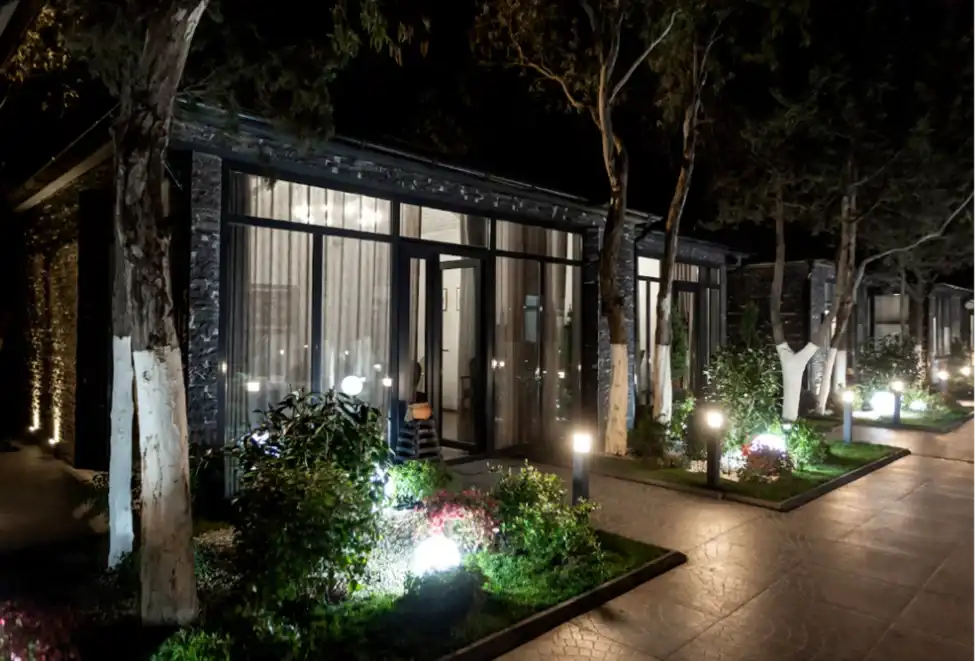
Having an integrated system, architectural lighting can be adjusted to ensure the consistent intensity and color of the pathways, landscapes, and structural elements. This is done to make sure that all the elements in the space relate visually to others.
Moreover, critical control enables major features, materials, and textures to shine through. Because of this, the environment seems to be in balance, well-organized, and consciously designed without visual distractions.
5. Safety and Visibility Through Intelligent Design
In outdoor settings, safety is one of the major considerations, particularly in high mobility locations. Inadequate lighting may result in shadows and glare that lead to a low level of visibility, and navigation is not easy.
This is addressed through architectural lighting that brings together design and responsive technology. A lighting system should be able to change the brightness level according to the level of activity, and this guarantees that a place with heavy traffic receives sufficient lighting.
Meanwhile, the less noisy areas are balanced more softly in order to prevent unnecessary brightness.
In addition, proper positioning reduces glare and improves clarity across the space. This creates an environment that supports both safety and comfort. As a result, lighting becomes a functional part of the design rather than a separate element.
6. Scalability Supports Future Expansion
As outdoor spaces continue to evolve, lighting systems must be flexible enough to adapt without requiring complete replacement. Changes in layout, increased usage, or new functional requirements often make rigid systems inefficient and costly to modify.
Architectural lighting systems address this by offering scalable solutions that can grow with the space. You can add new fixtures, extend coverage, or adjust lighting zones without disrupting the existing setup. This ensures that any expansion remains visually and functionally consistent.
In addition, integrated controls make it easier to update lighting patterns and performance based on new requirements. These systems can also connect with automation and energy management solutions, supporting long-term efficiency. As a result, lighting remains adaptable, consistent, and aligned with future development needs.
Conclusion
Architectural lighting has moved beyond basic illumination and now plays a central role in shaping outdoor environments. By integrating technology with design, you gain better control, improved efficiency, and a more consistent visual experience.
At the same time, data-driven insights and scalable systems ensure that your lighting remains effective as needs change. This approach allows you to create outdoor spaces that are not only functional but also aligned with long-term goals.
When design and technology work together, lighting becomes a reliable system that supports both performance and visual clarity.