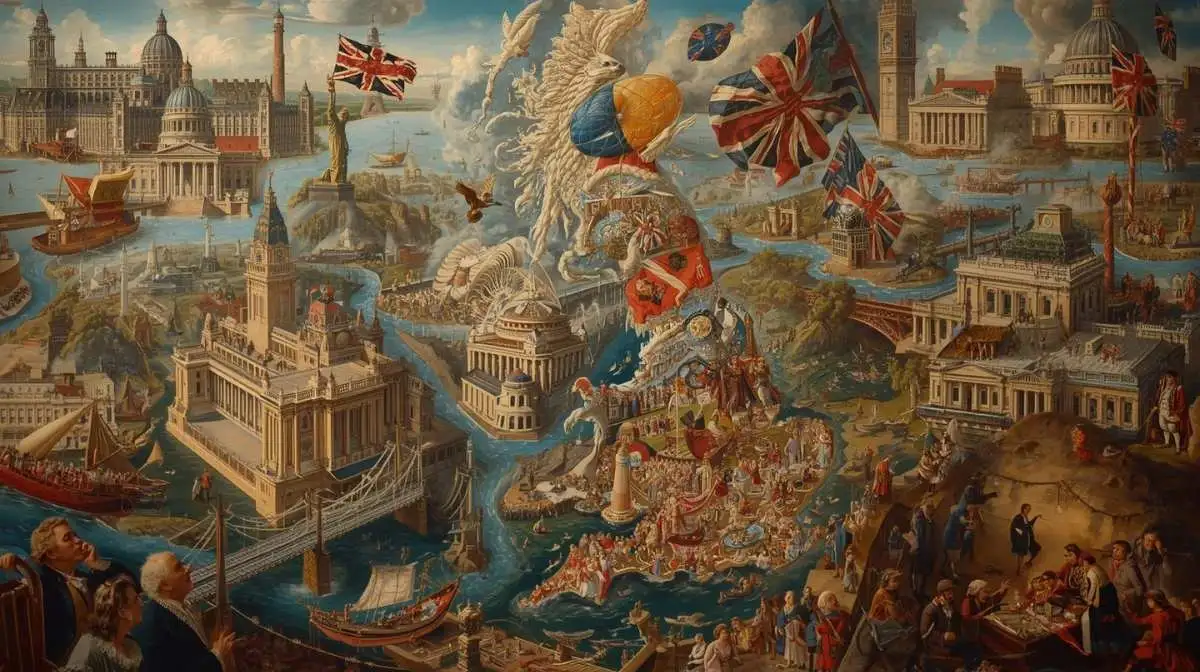
The United Kingdom (UK) is a country with a rich and complex history, spanning thousands of years. From prehistoric times to the modern era, the story of the UK is one of change, innovation, challenges, and triumphs. In this article, we will explore the fascinating history of the UK, starting from its earliest human settlements and moving through to its current role as a global power.
1. Prehistoric Britain: The Dawn of Time
Early Settlements
The story of Britain begins long before written history. The first humans arrived on the island more than 800,000 years ago, during the Paleolithic or Old Stone Age.
Evidence from archaeological digs suggests that these early humans, such as Homo erectus, lived in simple shelters and hunted large animals like mammoths and woolly rhinos. Over time, these early people adapted to the changing environment as the Ice Age ended and Britain’s landscape evolved.
As the glaciers receded, the land was transformed, leading to the development of new ecosystems. The first settlers were likely drawn to Britain because of its abundant resources, such as game, water, and fertile land.
The most famous early human structure is Stonehenge, a mysterious stone circle located in Wiltshire, England. Built around 3000 BC, the purpose of Stonehenge remains one of the great mysteries of prehistory, with some suggesting it served as an astronomical observatory, a religious site, or a burial ground.
The Bronze Age and Iron Age
The advent of metalworking brought the Bronze Age (around 2000 BC) to Britain. Bronze tools and weapons were used for farming, hunting, and trade.
As the Bronze Age progressed, settlements became more complex, and trade networks were established with other parts of Europe.
By 800 BC, Britain entered the Iron Age, a period that saw the widespread use of iron for making tools and weapons.
During this time, the Celtic tribes began to dominate the island. The Celts built hill forts, created intricate metalwork, and developed a rich oral tradition that would influence British culture for centuries.
READ THIS ALSO: DISCOVERY OF USA
2. The Roman Invasion: A New Chapter Begins
Roman Britain: The Rise of the Empire
In 43 AD, the Roman Empire, under the leadership of Emperor Claudius, invaded Britain. The Romans were driven by the need to expand their empire and control the resources of Britain, especially its valuable tin and iron.
They quickly established the province of Britannia, and for the next four centuries, Roman influence would shape the development of the island.
The Romans introduced advanced infrastructure to Britain, including the construction of roads, bridges, and towns. The most famous of these is Hadrian’s Wall, built in the 2nd century AD to protect Roman-controlled Britain from attacks by northern tribes.
The Romans also established Londinium (modern-day London) as a bustling trade hub and administrative center.
The Decline of Roman Britain
Despite the Roman Empire’s achievements, their rule in Britain began to weaken by the early 5th century. The Empire faced increasing pressure from external forces, including barbarian invasions and internal unrest.
In 410 AD, the Roman legions withdrew from Britain, leaving the island vulnerable to further invasions from Germanic tribes, such as the Angles, Saxons, and Jutes.
This marked the end of the Roman era in Britain and ushered in a period of uncertainty and upheaval, as the island transitioned into the Anglo-Saxon period.
3. The Anglo-Saxons: Building the Foundations of England
The Arrival of the Anglo-Saxons
Following the Roman withdrawal, Britain was left exposed to new settlers. The Anglo-Saxons, a collection of Germanic tribes from present-day Denmark, Germany, and the Netherlands, began to settle in the island around the 5th century.
These tribes brought with them their own languages, customs, and religious beliefs.
By the 6th century, the Anglo-Saxons had established several kingdoms in Britain, including Wessex, Mercia, Northumbria, and East Anglia.
These kingdoms were often in conflict with one another, fighting for land, resources, and dominance. The Anglo-Saxons also introduced their own form of law and government, which would lay the foundation for later English legal systems.
Christianity and the Rise of Wessex
One of the most important developments during this period was the spread of Christianity throughout Britain. In the 6th century, St. Augustine of Canterbury, sent by Pope Gregory I, arrived in Kent to convert the Anglo-Saxons to Christianity.
Over the next few centuries, Christianity became deeply embedded in Anglo-Saxon society, with monasteries and churches established across the land.
By the 9th century, the kingdom of Wessex emerged as the most powerful Anglo-Saxon kingdom. Under the leadership of Alfred the Great, Wessex successfully defended against Viking invasions, solidifying Alfred’s reputation as one of England’s greatest monarchs.
Alfred also made significant contributions to education and legal reforms, helping to unite the Anglo-Saxon kingdoms.
4. The Viking Age: A Time of Raiders and Settlers
Viking Raids and Invasions
From the late 8th century onward, Britain was subjected to frequent attacks from Viking raiders. These Norse seafarers, primarily from Denmark and Norway, initially targeted monasteries and coastal settlements.
Over time, however, the Vikings established more permanent settlements in Britain, particularly in the northern and eastern parts of the island.
The Viking raids were initially seen as destructive, but they also had a lasting impact on British society. The Vikings introduced new technologies, agricultural practices, and art forms.
They also played a key role in the development of the Danelaw, a Viking-controlled region in the northeast of England.
The Rise of Viking Kingdoms
By the 9th and 10th centuries, the Vikings had established several kingdoms in Britain, including the kingdom of York in the north.
Viking rulers, such as Sweyn Forkbeard and Cnut the Great, became powerful figures in British history. Cnut, in particular, ruled not only over England but also Denmark and Norway, forming what is known as the North Sea Empire.
Despite the Vikings’ success in Britain, their control was eventually broken by the forces of King Æthelstan of Wessex. By the mid-11th century, the Vikings had lost their foothold in England, marking the end of the Viking Age.
5. The Norman Conquest: A New Ruler Takes the Throne
The Battle of Hastings
In 1066, a dramatic event occurred that would change the course of English history: the Norman Conquest. After the death of King Edward the Confessor, a dispute over the English throne led to the invasion of William the Conqueror, the Duke of Normandy.
William claimed that he was the rightful heir to the throne, and after defeating the Anglo-Saxon king Harold II at the Battle of Hastings, William became the first Norman King of England.
Norman Rule and Feudalism
The Norman Conquest brought significant changes to England. William introduced the feudal system, a hierarchical system where land was divided into estates, which were controlled by lords who swore allegiance to the king.
This system reshaped English society, creating a rigid class structure and changing the political and economic landscape of the country.
The Normans also brought with them French culture and language, which had a profound impact on the development of the English language. Many French words were incorporated into the English vocabulary, particularly in law, government, and the arts.
The Domesday Book
One of William’s most enduring legacies was the Domesday Book, a comprehensive survey of all the land and resources in England. Completed in 1086, the Domesday Book was used by the monarchy to assess taxes and determine how much land each landowner held.
It remains an invaluable historical record and provides a detailed snapshot of life in medieval England.
6. The Plantagenet Dynasty: Growth, Conflict, and Reform
The Rise of the Plantagenets
The Plantagenet dynasty ruled England from the 12th to the 15th century. The dynasty’s first king, Henry II, established a powerful and centralized monarchy.
Henry’s reign saw significant legal reforms, including the development of common law, a legal system that would influence much of the English-speaking world.
Under Richard the Lionheart and his brother King John, England was embroiled in the Hundred Years’ War with France, a long and costly conflict that lasted from 1337 to 1453. The war had significant social, economic, and political consequences for both countries.
The Magna Carta
In 1215, King John was forced to sign the Magna Carta, a document that limited the powers of the monarchy and granted certain rights to the nobility.
The Magna Carta is one of the cornerstones of English democracy, and its principles have been echoed in the development of modern human rights and constitutional law.
The Black Death and the Peasants’ Revolt
The 14th century saw two major events that shaped English society: the Black Death and the Peasants’ Revolt.
The Black Death, a devastating plague, killed approximately one-third of England’s population between 1347 and 1351. The loss of life led to labor shortages and a decline in agricultural productivity.
The Peasants’ Revolt of 1381 was a direct response to the social and economic upheavals caused by the plague and the heavy taxes imposed by the monarchy.
Although the revolt was crushed, it marked an important moment in the history of England’s relationship with its rulers.
CLICK HERE FOR MORE INTERESTED BLOGS
7. The Tudor Dynasty: A New Age of Exploration and Religious Change
The Rise of the Tudors
The Tudor dynasty began with Henry VII in 1485 after his victory at the Battle of Bosworth Field, which ended the Wars of the Roses between the House of Lancaster (his family) and the House of York.
Henry VII’s reign marked the beginning of a more stable period for England. He restored peace and strengthened the monarchy through careful diplomacy and economic policies.
However, it was Henry VIII, Henry VII’s son, who made the most lasting impact on England. Henry’s reign (1509–1547) is famous for his break with the Catholic Church and his establishment of the Church of England.
Henry VIII and the English Reformation
Henry VIII’s desire for a male heir led him to seek an annulment of his marriage to Catherine of Aragon in the 1520s. When the Pope refused to grant the annulment, Henry broke away from the Catholic Church, declaring himself the Supreme Head of the Church of England.
This event, known as the English Reformation, had profound political, religious, and social consequences.
The Reformation led to the dissolution of the monasteries between 1536 and 1541, which resulted in the destruction of many religious buildings and the redistribution of their wealth and land.
It also contributed to the rise of Protestantism in England and the eventual consolidation of power by the monarchy.
The Elizabethan Era: A Golden Age
After the tumultuous reigns of Henry VIII’s children (Mary I and Edward VI), Elizabeth I came to the throne in 1558. Her reign, often referred to as the Elizabethan Era, is considered one of the greatest in English history.
Elizabeth’s policies established Protestantism as the dominant religion in England, and she worked to solidify England’s position as a maritime power.
One of the most iconic moments of Elizabeth I’s reign was the defeat of the Spanish Armada in 1588. Spain, under King Philip II, attempted to invade England, but the English navy, supported by bad weather, famously defeated the Armada.
This victory established England as a dominant naval power and marked the start of its rise as a global empire.
Elizabeth’s reign also saw the flourishing of English literature, with the works of playwrights like William Shakespeare and Christopher Marlowe defining an era of cultural achievement. The arts, exploration, and trade all flourished, making the Elizabethan era a period of great national pride.
8. The Stuart Period and the English Civil War: A Nation Divided
The Stuart Family and Early Tensions
In 1603, after the death of Elizabeth I, the Stuart dynasty took control of the English throne. James I, the son of Mary, Queen of Scots, succeeded Elizabeth, and his reign marked the beginning of a new era.
James, who had been King of Scotland as James VI, sought to unite England and Scotland under one crown. This ambition ultimately led to tension between the monarchy and Parliament, which would only escalate in the following decades.
James I’s successor, Charles I, would face even greater challenges. Charles believed in the divine right of kings, the idea that monarchs were answerable only to God.
This belief put him at odds with Parliament, which sought to limit his power. Over time, tensions between Charles and Parliament grew, particularly over issues of taxation and religious reform.
The English Civil War
The English Civil War (1642–1651) was one of the most defining events in British history. It was fought between the Royalists (those loyal to King Charles I) and the Parliamentarians (those supporting Parliament).
The war ended with the defeat of Charles I’s forces and his eventual execution in 1649. This was the first time in history that an English monarch was tried and executed by his own people.
After Charles’s death, England was briefly turned into a republic under the leadership of Oliver Cromwell, who became the Lord Protector. Cromwell’s rule, known as the Commonwealth, marked a significant shift in English politics.
While Cromwell aimed to create a more equitable society, his harsh rule and military dictatorship led to disillusionment, and after his death in 1658, the monarchy was restored in 1660 with the ascension of Charles II.
The Glorious Revolution
The final blow to absolute monarchy in England came in 1688 with the Glorious Revolution. King James II, a Catholic, was overthrown in a peaceful coup led by his Protestant daughter Mary II and her husband William of Orange.
William and Mary were invited to take the throne by the English nobility, and they agreed to govern with the consent of Parliament.
This revolution marked the end of the divine right of kings and the beginning of constitutional monarchy. It was followed by the signing of the Bill of Rights in 1689, which guaranteed certain civil liberties and further limited the powers of the monarchy.
9. The Georgian and Victorian Eras: Industrialization, Empire, and Social Change
The Georgian Era: The Rise of the British Empire
The Georgian era, which spanned from 1714 to 1830, saw the rise of Great Britain as a global power. Under George III, Britain expanded its empire, particularly in North America, Africa, and Asia.
However, this period also saw increasing tensions with the American colonies, which eventually led to the American Revolution (1775–1783). Despite losing the colonies, Britain continued to build its empire through trade, colonization, and naval supremacy.
The late Georgian period also saw the growth of industrialization in Britain. The Industrial Revolution, which began in the late 18th century, transformed the economy and society. Factories, railroads, and urbanization changed the landscape, leading to significant social and economic changes.
The Victorian Era: The Height of the British Empire
The Victorian era (1837–1901), named after Queen Victoria, was a period of great expansion for the British Empire. At its height, the British Empire controlled vast territories in Africa, India, the Caribbean, and the Pacific, making Britain the largest empire the world had ever seen. The phrase “the sun never sets on the British Empire” symbolized the empire’s global reach.
Industrialization and Reform
During the Victorian period, Britain underwent dramatic changes. The rise of factories, mass production, and the growth of cities led to the creation of a new working class.
The rapid industrialization brought with it significant social problems, including overcrowded cities, poor working conditions, and child labor.
In response, the Victorian government enacted numerous social reforms aimed at improving the lives of the working class. These included factory acts, which limited working hours and conditions, as well as the establishment of the National Health Service and public education systems.
Cultural and Intellectual Flourishing
The Victorian period was also a time of intellectual, cultural, and scientific advancement. Great literary figures like Charles Dickens, Charlotte Brontë, and George Eliot wrote novels that addressed social issues, and scientists like Charles Darwin introduced groundbreaking theories on evolution. This period saw a flourishing of British art, literature, and philosophy that influenced the world.
10. The 20th Century: World Wars, Decline of Empire, and Modern Britain
World War I: The Great War
The outbreak of World War I in 1914 marked the beginning of a new chapter in British history. Britain, along with its allies, fought against the Central Powers, including Germany and Austria-Hungary. The war had devastating effects on Britain, with over 700,000 British soldiers losing their lives.
The war also resulted in significant social and economic changes, including the expansion of women’s rights, as women took on roles traditionally held by men during the war.
World War II: The Fight for Survival
World War II (1939–1945) was even more devastating than World War I. Britain, again part of the Allied Powers, faced the threat of Nazi Germany and the Axis Powers. The war caused significant loss of life and damage to infrastructure, but it also led to the eventual defeat of Hitler’s regime.
The war left Britain economically weakened, and the Welfare State was established to ensure that every citizen had access to education, healthcare, and social services.
The National Health Service (NHS) was founded in 1948, providing universal healthcare to all British citizens, which became a hallmark of post-war British society.
Decolonization and the End of the British Empire
After World War II, the British Empire began to unravel. Many of Britain’s colonies, particularly in Africa and Asia, gained independence, and the British Empire shrank rapidly.
India gained independence in 1947, followed by many other countries in the decades that followed. By the 1960s, Britain’s empire had effectively come to an end, marking the beginning of a new era in international relations.
Modern Britain: A Globalized Nation
In the latter half of the 20th century and into the 21st century, Britain became an important player in international diplomacy, economics, and trade. Britain joined the European Union in 1973, which led to significant economic integration with the continent.
However, the United Kingdom made headlines again in 2016, when the Brexit referendum was held, and the British public voted to leave the European Union. This decision marked a major turning point in the nation’s relationship with Europe and the world, as Britain began to navigate its future outside the EU.
Conclusion: A Nation Shaped by History
The history of the United Kingdom is a long and complex one, filled with triumphs, struggles, and moments of profound change.
From its early days as a collection of tribes and kingdoms to its rise as a global superpower, the UK’s journey has shaped not only the nation itself but the world at large. Today, the UK faces new challenges and opportunities, but its rich history continues to influence its path forward.