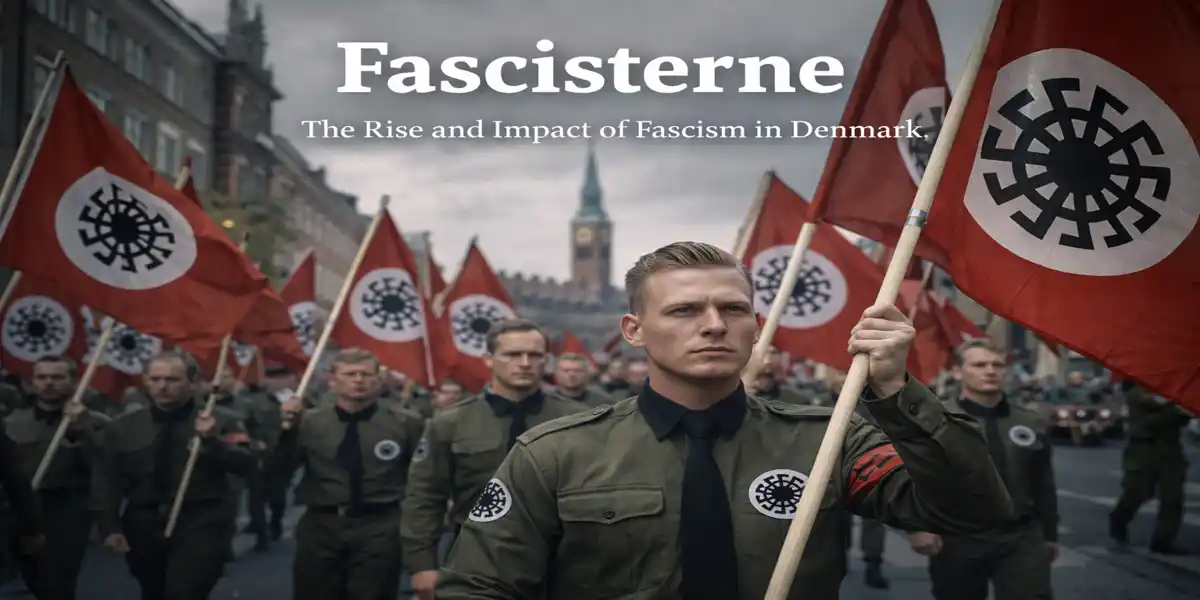
Quick answer: “Fascisterne” is the Danish plural for fascists, but Denmark did not have one unified movement known by that name. The country’s most important Nazi party was Danmarks Nationalsocialistiske Arbejderparti (DNSAP), founded in 1930. It copied much of German Nazism but remained politically marginal, winning three parliamentary seats in both 1939 and 1943. Germany occupied Denmark from 1940 to 1945, while Danish resistance grew and most Danish Jews escaped to Sweden in 1943.
What Does Fascisterne Mean in Danish History?
The Danish word fascisterne literally means “the fascists.” It can describe people or groups that supported fascist or Nazi ideas, but historians do not normally use it as the formal name of a single Danish political organisation.
For Denmark in the 1930s and during the Second World War, the central organisation was the Danish National Socialist Workers’ Party, commonly shortened to DNSAP. Smaller authoritarian and nationalist groups also existed, so Danish fascism was broader than one party.
This distinction matters because the original article risked presenting “Fascisterne” as a unified movement that controlled Danish politics. In reality, Danish Nazis gained visibility and support from the German occupation authorities, but they never won mass electoral backing.
Fascism, Nazism and Danish Political Context
Fascism developed in Europe after the First World War through movements that rejected liberal democracy, promoted authoritarian leadership and placed the nation above individual rights. Italian Fascism and German National Socialism were related but not identical political systems.
Nazism added an explicitly racial worldview, antisemitism and the pursuit of territorial expansion. Danish Nazis borrowed heavily from Hitler’s movement, including its symbols, leadership model, propaganda style and hostility toward parliamentary democracy.
Denmark remained a constitutional democracy during the interwar period. Economic pressure after the global depression created political frustration, but established democratic parties continued to attract the overwhelming majority of voters.
Key Timeline of Danish Fascism and Nazism
| Year | Event | Why it matters |
|---|---|---|
| 1930 | DNSAP was founded | Created Denmark’s principal Nazi party |
| 1933 | Frits Clausen became party leader | The party moved closer to the German Nazi model |
| 1939 | DNSAP won three parliamentary seats | Showed limited electoral support before occupation |
| 9 April 1940 | Germany occupied Denmark | Changed the party’s influence and public perception |
| 1943 | DNSAP again won three seats | Demonstrated that occupation had not created mass support |
| October 1943 | Most Danish Jews escaped to Sweden | Became a major episode of civilian and resistance action |
| May 1945 | Denmark was liberated | Nazi organisations collapsed and collaborators faced legal proceedings |
Formation of the DNSAP
DNSAP was founded in 1930, not by Frits Clausen alone. Clausen joined the relatively new organisation in 1931 and took control in 1933 after replacing its first leader, Cay Lembcke. He then strengthened the party’s imitation of Germany’s National Socialist movement.
The party promoted authoritarian government, antisemitism, anti-communism and an ethnic definition of Danish identity. Its uniforms, marches and propaganda deliberately echoed Nazi practices, although Danish national questions sometimes created tension with its German model.
According to the historian Niels Wium Olesen writing for Danmarkshistorien at Aarhus University, Clausen led DNSAP from 1933 and maintained a strongly German-inspired line. This source also makes clear that the party failed to obtain broad Danish support.
How Much Support Did Danish Nazis Receive?
DNSAP entered parliament with three seats in the 1939 election. German occupation might have appeared to offer the party a path to power, especially because the occupiers supported it financially and allowed its press and organisation to operate beyond what its membership alone could sustain.
However, the German authorities did not install Clausen as Denmark’s ruler. For much of the occupation, they preferred working with the existing Danish government because cooperation helped maintain order and production.
The March 1943 election became an important test. DNSAP mobilised roughly 43,000 votes but still secured only three seats. High turnout and strong support for democratic parties made the result a political defeat for the Danish Nazis, despite the occupation conditions.
This evidence corrects the misleading idea that fascism broadly captured Denmark’s working class or transformed the country into a Danish Nazi state. Some citizens supported or collaborated with the movement, but most voters rejected it.
German Occupation and the Policy of Cooperation
German forces invaded Denmark on 9 April 1940. The Danish government surrendered quickly in the face of overwhelming military pressure and initially followed a policy of cooperation intended to preserve a degree of domestic administration.
Cooperation should not be confused with Denmark formally becoming fascist. Danish institutions continued to operate under occupation constraints, while the political situation changed significantly in August 1943 when the cooperation policy broke down and German control became more direct.
Public behaviour ranged from accommodation and collaboration to everyday non-compliance and organised resistance. A balanced history must recognise these different responses instead of describing all Danes either as collaborators or as active resistance members.
The Danish Resistance Movement
Resistance developed gradually rather than appearing as one unified organisation at the start of occupation. Individuals and groups produced illegal newspapers, gathered intelligence, helped people escape and carried out sabotage against German interests.
Sabotage and strikes increased as the war progressed. These actions contributed to the crisis of August 1943, after which the Danish government stopped functioning under the earlier cooperation arrangement.
The resistance was politically diverse and included communists, conservatives, nationalists and people with no strong party identity. What connected them was opposition to German occupation, although their methods and visions for post-war Denmark differed.
The Rescue of Danish Jews in 1943
One of the most significant events in occupied Denmark occurred after plans to arrest and deport Danish Jews became known in autumn 1943. Jewish families were warned, hidden and helped toward the coast before being transported across the water to neutral Sweden.
The United States Holocaust Memorial Museum reports that more than 7,000 Jews and close to 700 non-Jewish relatives reached Sweden in a little over three weeks. Around 500 Jews were captured and deported to Theresienstadt.
The rescue involved Danish citizens, fishermen, resistance members and others. It is often remembered as a powerful example of collective action, but it should not erase the danger faced by those deported or the existence of Danish Nazi supporters and collaborators.
What Happened to DNSAP After the War?
DNSAP’s political position collapsed with Germany’s defeat and Denmark’s liberation in May 1945. Clausen had already lost authority within the movement, and he was arrested after liberation. He died in prison in 1947 before his case reached a final judgment.
It is more accurate to say that DNSAP ceased operating after liberation than to make a broad claim that every fascist organisation was immediately “banned.” Denmark conducted a legal reckoning in which collaborators could be prosecuted under post-war legislation.
The process remains historically debated because it involved retrospective laws, difficult questions about cooperation and collaboration, and disagreements over individual responsibility under occupation.
How Media and Popular Culture Shape This History
Films, documentaries and celebrity-led historical programmes can introduce audiences to the occupation, the resistance and the rescue of Danish Jews. However, dramatic storytelling often compresses timelines or divides people into simple heroes and villains.
Viewers should compare entertainment accounts with museum collections, academic histories and primary records. The same critical approach is useful when reading broad national-history explainers such as the history of the United Kingdom or how old America is.
Historical fame also changes over time. Political leaders, resistance figures, broadcasters and actors may become public symbols, but their popularity is not evidence that every story told about them is accurate.
Why the History of Fascisterne Still Matters
The Danish case shows that extremist parties can gain attention without winning majority support. It also demonstrates how foreign occupation, propaganda and political pressure can change the space in which democratic institutions operate.
The term fascism should be used carefully. Not every nationalist or anti-immigration position is automatically fascist, while genuine fascist movements should not be softened into ordinary political disagreement. Historians examine ideology, organisation, political violence, leadership and attitudes toward democracy.
Long historical comparisons also require context. Our article on major changes in human history looks at how simplified stories can shape public understanding, while 1900s and 2000s fashion shows how later generations reinterpret the past through culture.
Common Misconceptions
- “Fascisterne” was one official party: It is a general Danish word; DNSAP was the principal Nazi party.
- Frits Clausen founded DNSAP in 1930: He joined in 1931 and became leader in 1933.
- Danish Nazis became politically dominant: DNSAP remained marginal and won three seats in both 1939 and 1943.
- All Danes resisted occupation: Responses included resistance, accommodation, passivity and collaboration.
- Every Danish Jew escaped: Most reached Sweden, but roughly 500 were deported to Theresienstadt.
Frequently Asked Questions
What does Fascisterne mean?
Fascisterne means “the fascists” in Danish. It is not the formal name of a single historical party.
What was Denmark’s main Nazi party?
The principal Danish Nazi party was Danmarks Nationalsocialistiske Arbejderparti, usually abbreviated as DNSAP.
Did fascists rule Denmark?
No. Germany occupied Denmark, but DNSAP was never given control of the country and did not win broad electoral support.
How many seats did DNSAP win in 1943?
DNSAP won three parliamentary seats in 1943, the same number it had secured in 1939.
How many Danish Jews escaped to Sweden?
More than 7,000 Jews escaped to Sweden during the rescue operation in 1943, along with hundreds of non-Jewish relatives.
Conclusion
The history behind “Fascisterne” is not the story of Denmark embracing fascism as a nation. It is the story of a marginal Nazi movement operating during economic crisis, dictatorship’s rise elsewhere in Europe and five years of German occupation.
DNSAP gained resources and attention but failed to win mass political support. Danish responses to occupation were complex, ranging from cooperation and collaboration to sabotage and rescue. Using verified dates, election results and Holocaust evidence produces a clearer account than treating the period as a simple struggle between two uniform sides.