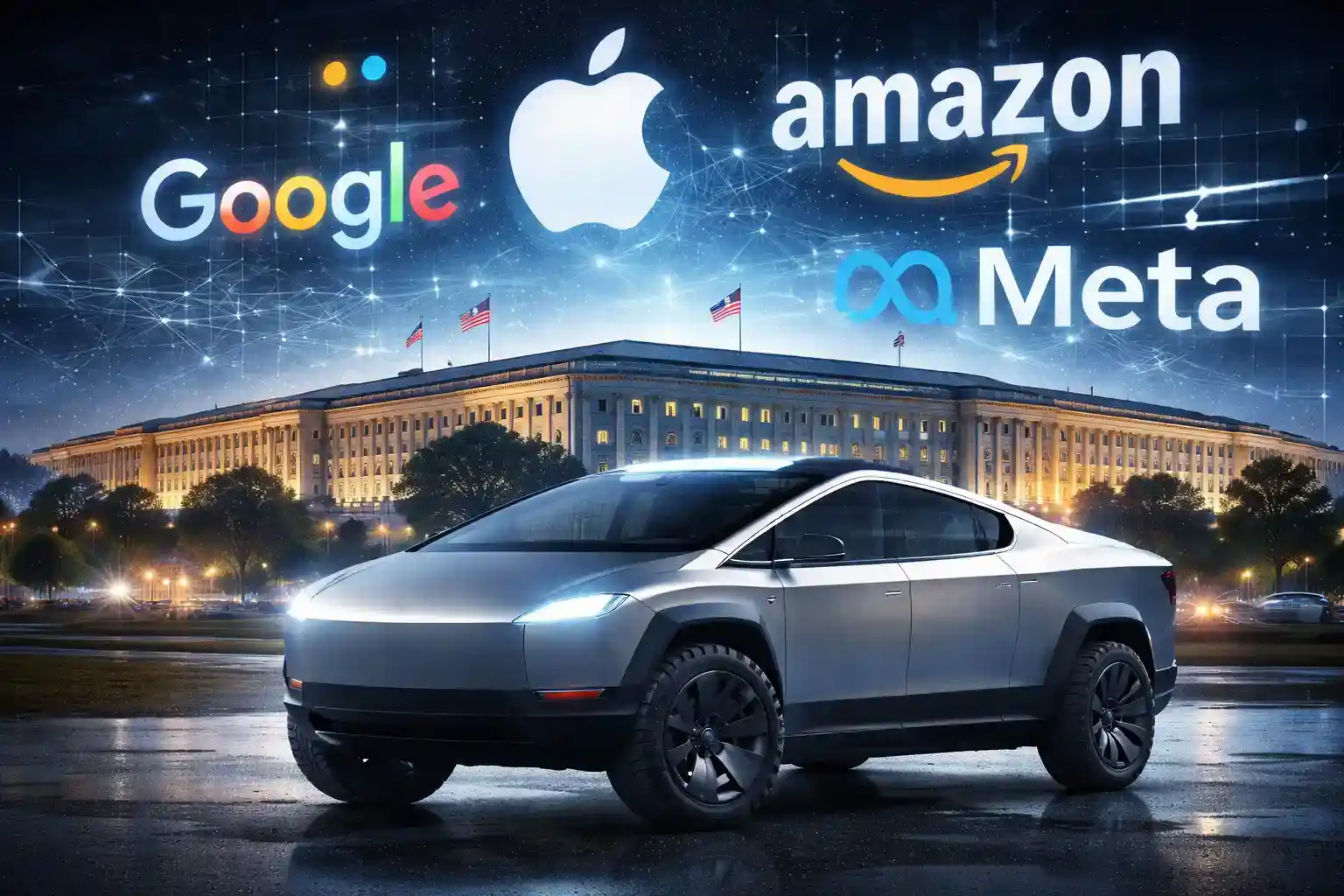
Quick answer: The Pentagon’s relationship with Big Tech is real, but claims that the Tesla Cybertruck has become a U.S. military combat vehicle are unsupported. In 2025, U.S. Air Force procurement documents reportedly identified two Cybertrucks as potential target vehicles for weapons testing, not as operational trucks. The wider story concerns cloud computing, artificial intelligence, satellites, cybersecurity and the growing role of private technology companies in defence.
Pentagon, Big Tech and Tesla Cybertruck Explained
The U.S. Department of Defense has worked with private technology companies for decades. What has changed is the scale and strategic importance of software, cloud infrastructure, artificial intelligence, satellite communications and commercial data.
Tesla’s Cybertruck is often pulled into this discussion because its unusual stainless-steel body and electric drivetrain attract attention online. However, viral speculation frequently moves faster than confirmed procurement records. A consumer vehicle appearing in a military document does not automatically mean the Pentagon has adopted it for combat.
What the Pentagon Actually Buys From Big Tech
Modern defence operations depend on far more than weapons and vehicles. Military organisations need secure computing, data storage, communications, mapping, logistics software and tools that help commanders understand large volumes of information.
- Cloud infrastructure: secure environments for storing and processing defence data.
- Artificial intelligence: tools for analysis, maintenance, planning and decision support.
- Cybersecurity: protection for networks, devices and sensitive information.
- Satellite services: communications, imagery and positioning support.
- Autonomous systems: software and sensors for aircraft, ground vehicles and maritime platforms.
These contracts raise practical and ethical questions. Government agencies must consider security clearances, supply-chain risk, vendor dependence, data ownership and whether commercial systems can meet military reliability standards.
Was the Tesla Cybertruck Chosen as a Military Vehicle?
No verified evidence shows that the standard Tesla Cybertruck has been adopted as an operational U.S. military combat vehicle. Reports in August 2025 described an Air Force effort to obtain two Cybertrucks among 33 vehicles for target testing connected with precision-guided munitions.
In that context, the vehicles were expected to represent possible battlefield targets rather than transport troops. Reporting indicated that planners believed adversaries might use vehicles with Cybertruck-like construction, making realistic target testing useful.
This is different from a military purchase for reconnaissance, logistics or tactical patrol. The distinction should remain clear in titles, introductions and social-media summaries so readers are not given a false impression.
Confirmed Facts and Common Claims
| Claim | Evidence status | What readers should know |
|---|---|---|
| The Pentagon uses Big Tech services | Confirmed | Cloud, AI, cyber and satellite contracts are established areas |
| Cybertrucks appeared in Air Force procurement material | Reported in 2025 | They were described as target vehicles for testing |
| Cybertruck is an official U.S. combat vehicle | Not confirmed | No evidence supports standard military adoption |
| Its steel body makes it fully bulletproof | Misleading | Durability claims depend on the threat, test and vehicle configuration |
| Electric vehicles can support defence logistics | Possible in some roles | Range, charging, repair and mission demands determine suitability |
Could Electric Vehicles Work in Military Operations?
Electric vehicles may be useful for controlled bases, short-range transport or specialised support roles. They can offer quiet low-speed operation, immediate torque and fewer conventional engine components. Those advantages do not make every EV suitable for a battlefield.
Military vehicles operate with heavy payloads, damaged roads, extreme weather and uncertain supply lines. Charging infrastructure can be difficult to deploy, while battery performance changes with temperature, speed, towing and terrain.
A reliable assessment compares the complete system: vehicle, energy source, spare parts, trained technicians, software access and recovery options. The same practical approach is useful when evaluating consumer energy claims in our guide to whether solar panels with a battery are worth it.
Cybertruck Strengths and Military Limitations
Stainless-steel exterior
The Cybertruck’s exterior may resist some dents and everyday damage, but military protection is measured against defined ballistic and blast standards. A commercial body panel is not a substitute for certified armour, mine protection or a purpose-built survivability system.
Electric power and range
Electric drive can reduce local exhaust emissions and noise, yet usable range falls when a vehicle carries heavy loads, travels off-road or operates in severe weather. Recharging time and access to power also matter during dispersed operations.
Software dependence
Connected vehicles rely on software, sensors and electronic control systems. Military buyers must examine cyber risk, remote updates, data collection, component sourcing and whether the vehicle can keep operating when communications are unavailable.
Why Big Tech Partnerships Are Controversial
Technology companies can deliver expertise faster than a government builds every capability internally. The trade-off is long-term dependence on private vendors whose priorities, leadership and commercial markets can change.
Defence contracts may also create conflicts over worker participation, responsible AI and the use of consumer-derived technology in warfare. Transparent procurement, independent testing and clear human accountability are essential when automated systems affect high-stakes decisions.
Readers interested in how automated systems evaluate digital material can compare these issues with our explanation of an AI image detector. The applications differ, but both depend on training data, accuracy limits and responsible human review.
The Celebrity and Public-Figure Effect
Elon Musk’s public profile makes any Tesla-related government document a major news story. Celebrity leadership can draw attention to engineering, but personality should not replace evidence about contracts, testing or operational use.
Online audiences often merge Musk’s work at Tesla, SpaceX and other companies into one narrative. Each company has separate products and government relationships, so claims should be checked against the specific agency, contract and date involved.
This distinction also matters across creator culture. Our article on LittleminaXO’s social media strategy explains how public visibility shapes audience interpretation, while the technology claims themselves still require independent verification.
How to Verify a Military Technology Story
- Check whether the source describes a request, trial, award or completed deployment.
- Identify the purchasing agency and exact intended use.
- Separate a prototype or test target from operational adoption.
- Look for an official procurement document or agency statement.
- Check the publication date because contract status can change.
- Avoid treating company marketing as independent performance evidence.
The same source-checking method applies to unfamiliar technology sites. Before relying on a review, examine who published it, what was tested and whether claims can be reproduced. Our expert laptop reviews guide covers similar evaluation principles for consumer technology.
Frequently Asked Questions
Did the Pentagon buy Tesla Cybertrucks?
Reports said the Air Force sought two Cybertrucks in 2025 as target vehicles for weapons testing. That is not the same as adopting them for operational military use.
Is the Cybertruck bulletproof?
Broad “bulletproof” claims are misleading without a defined threat and certified test. A commercial stainless-steel exterior should not be treated as military armour.
Why does the Pentagon work with Big Tech?
Private companies provide cloud computing, AI, cybersecurity, satellites, data analysis and other capabilities that are important to modern defence.
Could electric trucks serve on military bases?
Yes, they may suit some predictable transport roles, but mission range, charging, climate, payload and security requirements must be assessed first.
Conclusion
The real Pentagon and Big Tech story is larger than one attention-grabbing vehicle. Commercial cloud, AI, cyber and satellite companies increasingly support defence work, creating both useful capabilities and serious oversight questions.
As of the reported 2025 procurement activity, Cybertrucks were associated with target testing rather than confirmed combat deployment. Keeping that distinction clear turns a speculative headline into accurate, useful technology reporting.