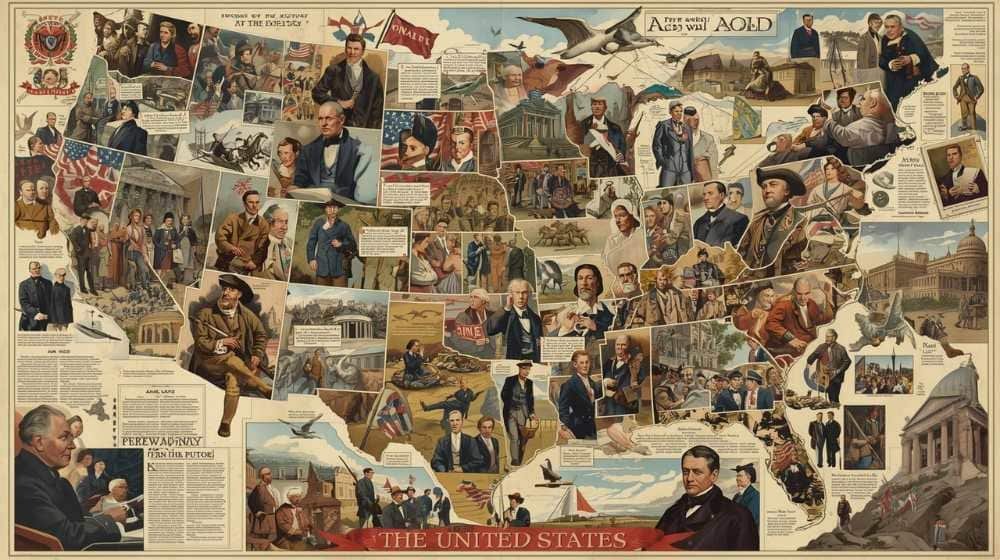
The United States of America, commonly referred to as the USA, is one of the most influential countries in the world today. However, its journey from a collection of colonies to a global superpower has been anything but straightforward. The story of how the United States was born, expanded, and evolved is a fascinating one—rich with struggles, triumphs, and moments of great transformation.
But how old is America? How did it begin, and what major events shaped the nation we know today? This article will take you through the history of the United States, covering its colonial beginnings, the fight for independence, the formation of its government, its expansion, and its rise to global prominence.
Let’s explore the deep roots of the United States, understand the key moments of its founding, and look ahead to where this great nation is headed in the future.
Who Discovered America the Country and How?
The “discovery” of America as a country refers to the Declaration of Independence on July 4, 1776. This was when the American colonies officially declared their independence from Britain and established themselves as a new, sovereign nation. The “discovery” here is not geographical but political, as it was the birth of the United States as an independent nation separate from colonial rule.
Thomas Jefferson, the primary author of the Declaration of Independence, and other leaders such as George Washington and Benjamin Franklin played key roles in the discovery of America as an independent nation. Their efforts, both in diplomacy and in the Revolutionary War, led to the recognition of the United States as a country.
The Colonial Era: The Early Foundations of America
Understanding the Origins of What Would Become the United States
Before Europeans arrived in what is now the United States, the land was home to a vast array of Indigenous peoples. These native tribes and civilizations had lived on the continent for thousands of years, developing rich cultures, languages, and systems of governance. Among the most notable of these civilizations were the Maya, Aztec, and Inca in the South, and the Iroquois, Cherokee, and Sioux in North America.
European colonization began in the late 15th century. In 1492, Christopher Columbus, under the Spanish flag, made his famous journey across the Atlantic and reached the Caribbean islands. However, the first English colony was founded in 1607 at Jamestown, Virginia. Over the following decades, other European powers—particularly the French and Dutch—established colonies along the Eastern Seaboard.
The English, however, would eventually dominate in terms of the number of colonies they established, ranging from the 13 Colonies in the 17th and 18th centuries. These colonies were primarily settled for economic gain, religious freedom, and trade routes. By the mid-1700s, the population in the English colonies was thriving, and these settlers began developing a distinct identity that was separate from their European roots.
The Road to Revolution: A Nation Begins to Rise
Key Events Leading to the American Revolution and the Desire for Independence
Throughout the 18th century, tensions began to grow between the American colonies and the British government. A variety of factors—such as the desire for more local control, high taxes, and British interference in colonial affairs—fueled discontent. The French and Indian War (1754-1763) had left Britain with a massive debt, and the British government imposed a series of taxes on the colonies to recoup these costs.
One of the earliest acts of resistance to British rule was the Stamp Act of 1765, which taxed printed materials in the colonies. This was followed by the Townshend Acts (1767), which placed taxes on everyday goods like glass, tea, and paper. The Boston Massacre (1770) further escalated tensions when British soldiers killed five colonists during a confrontation, sparking outrage.
The most famous act of rebellion came in 1773 when American colonists, protesting the Tea Act, disguised themselves as Native Americans and dumped British tea into Boston Harbor. This event, known as the Boston Tea Party, was a symbol of colonial resistance to British authority and further solidified the desire for independence.
July 4, 1776: The Declaration of Independence
The Official Birth of the United States as an Independent Nation
On July 4, 1776, the Second Continental Congress adopted the Declaration of Independence, declaring the American colonies’ formal separation from Britain. The Declaration, primarily written by Thomas Jefferson, listed grievances against King George III and explained the colonies’ decision to break away. It famously states:
“We hold these truths to be self-evident, that all men are created equal, that they are endowed by their Creator with certain unalienable Rights, that among these are Life, Liberty and the pursuit of Happiness.”
The signing of the Declaration marked the official birth of the United States. Although the fight for independence would continue for several years, this document set the course for a new nation founded on the principles of democracy, equality, and freedom.
The Revolutionary War: Fighting for Independence
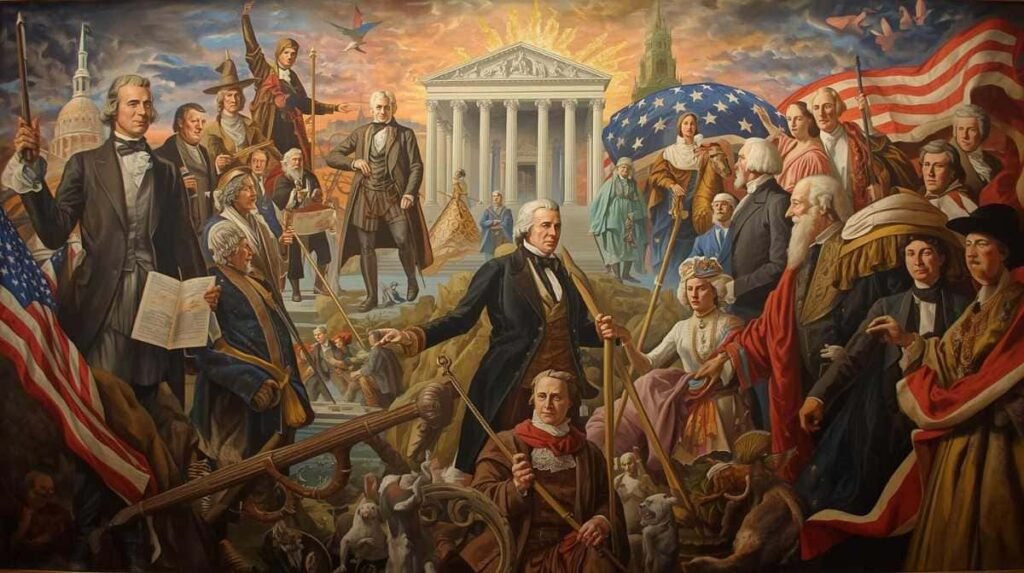
The Struggle That Defined the Birth of the United States
The American Revolutionary War (1775-1783) was a pivotal conflict between the 13 American colonies and the British Empire. The war began with the Battles of Lexington and Concord in April 1775, as colonial militias fought against British troops. Over the course of the war, key battles like Saratoga (1777) and Yorktown (1781) proved decisive, with the Americans securing crucial victories.
The colonists, led by figures such as George Washington, Thomas Paine, and Benjamin Franklin, fought not just for military independence, but for a new kind of government—one based on democratic principles and self-governance. With the help of France, which provided essential military support, the United States was able to defeat the British and secure its independence.
How Many Times Has America Been “Discovered”?
While Columbus is famously credited with “discovering” America in 1492, it is important to acknowledge that the land was already inhabited by millions of indigenous peoples. Columbus’s voyage did open the door for further European exploration and colonization, but it was not the first instance of “discovery.”
The Vikings, led by Leif Erikson, were likely the first Europeans to set foot in North America around 1000 AD, establishing a settlement called Vinland in what is now Newfoundland, Canada. This discovery, however, did not lead to the lasting colonization of the Americas.
Columbus’s “discovery” in 1492 is considered by many to be the pivotal moment that began the widespread European colonization of the Americas, even though it was not technically the first time the continent had been “discovered.”
America’s Age Timeline
This timeline shows the age of the United States in each year, marking its growth and progress from 1999 to 2050.
| Year | Age of America |
|---|---|
| 1999 | 223 years old |
| 2000 | 224 years old |
| 2001 | 225 years old |
| 2002 | 226 years old |
| 2003 | 227 years old |
| 2004 | 228 years old |
| 2005 | 229 years old |
| 2006 | 230 years old |
| 2007 | 231 years old |
| 2008 | 232 years old |
| 2009 | 233 years old |
| 2010 | 234 years old |
| 2011 | 235 years old |
| 2012 | 236 years old |
| 2013 | 237 years old |
| 2014 | 238 years old |
| 2015 | 239 years old |
| 2016 | 240 years old |
| 2017 | 241 years old |
| 2018 | 242 years old |
| 2019 | 243 years old |
| 2020 | 244 years old |
| 2021 | 245 years old |
| 2022 | 246 years old |
| 2023 | 247 years old |
| 2024 | 248 years old |
| 2025 | 249 years old |
| 2026 | 250 years old |
| 2027 | 251 years old |
| 2028 | 252 years old |
| 2029 | 253 years old |
| 2030 | 254 years old |
| 2031 | 255 years old |
| 2032 | 256 years old |
| 2033 | 257 years old |
| 2034 | 258 years old |
| 2035 | 259 years old |
| 2036 | 260 years old |
| 2037 | 261 years old |
| 2038 | 262 years old |
| 2039 | 263 years old |
| 2040 | 264 years old |
| 2041 | 265 years old |
| 2042 | 266 years old |
| 2043 | 267 years old |
| 2044 | 268 years old |
| 2045 | 269 years old |
| 2046 | 270 years old |
| 2047 | 271 years old |
| 2048 | 272 years old |
| 2049 | 273 years old |
| 2050 | 274 years old |
Who Lived in the USA Before It Was ‘Discovered’?
Before the arrival of Europeans, the land that would become the United States was home to millions of Indigenous peoples. These groups had been living on the continent for thousands of years, developing complex societies, cultures, and economies. The history of these peoples is incredibly diverse, with each tribe or nation having its own distinct way of life. Some of the major groups included:
- The Native American Tribes: The indigenous tribes of the Americas were spread across the entire continent, from the Arctic regions down to the southern tip of South America. Notable groups included the Navajo and Apache in the Southwest, the Iroquois and Algonquian in the Northeast, the Cherokee in the Southeast, and the Sioux on the Great Plains.
- The Mound Builders: In the Midwest and Southeast, ancient Native American cultures, such as the Mississippian and Hopewell cultures, built massive earthen mounds for burial, religious ceremonies, and as centers of trade. These cultures flourished for centuries before the arrival of Europeans.
- The Inuit and Other Arctic Peoples: In the far north, groups like the Inuit and Aleut peoples lived in the cold, harsh environments of Alaska and northern Canada, relying on hunting, fishing, and advanced survival skills.
- The Puebloans: In the Southwest, the Puebloan peoples, such as the Hopi, Zuni, and Taos tribes, developed sophisticated dwellings and agricultural systems that still survive today.
- The Plains Tribes: On the Great Plains, the Lakota, Cheyenne, Comanche, and other nomadic tribes thrived, relying on bison hunting for food, clothing, and tools.
These Indigenous peoples had developed their own rich cultures, languages, and systems of governance long before Europeans arrived. Their societies were deeply connected to the land and had developed sustainable agricultural practices, complex trade networks, and spiritual traditions. The arrival of Europeans disrupted these societies in profound ways, leading to the loss of land, culture, and lives for many native groups.
The United States Constitution: Establishing a New Government
The Creation of the Foundational Document That Would Govern the Nation
In 1787, after the Revolutionary War, the young United States needed to establish a framework for its government. The first attempt, the Articles of Confederation, proved to be weak and ineffective, particularly when it came to enforcing laws and collecting taxes.
In response, the Constitutional Convention was held in Philadelphia in 1787, where James Madison, Alexander Hamilton, and other founding fathers worked to create a new governing document. The U.S. Constitution, ratified in 1788, established the federal system of government with three branches: the executive, legislative, and judicial.
This system of checks and balances, along with the Bill of Rights (1791), laid the foundation for the United States as we know it today.
The Bill of Rights: Guaranteeing Freedoms and Rights
How the First Ten Amendments Shaped American Liberties
The Bill of Rights, the first ten amendments to the U.S. Constitution, was added in 1791 to protect individual liberties and limit government power. These amendments included essential freedoms such as:
- Freedom of speech, press, and religion
- Right to bear arms
- Protection from unreasonable searches and seizures
- Right to a fair trial
The Bill of Rights not only safeguarded personal freedoms but also set the stage for future civil rights movements, ensuring that the government could never infringe on the fundamental rights of the people.
Expanding the Nation: The Louisiana Purchase and Westward Expansion
America’s Journey from Coast to Coast and Its Quest for Land
In 1803, President Thomas Jefferson oversaw the purchase of Louisiana from France, doubling the size of the United States. This Louisiana Purchase opened up vast territories for settlement, and expeditions like the Lewis and Clark Expedition helped map the newly acquired lands.
By the mid-1800s, the concept of Manifest Destiny—the belief that it was America’s divine right to expand westward—drove the country to acquire more territory, including Texas, California, and the Oregon Territory. This expansion played a major role in shaping the U.S. into the continental power it is today.
The Civil War: A Nation Divided
The Conflict That Nearly Tore the United States Apart and the Road to Reconciliation
By the 1860s, the issue of slavery became the primary point of contention between the Northern and Southern states. The Northern states, where slavery was banned, and the Southern states, where it was integral to the economy, grew increasingly divided.
This division led to the Civil War (1861-1865), with the Confederacy fighting to maintain slavery, and the Union (led by President Abraham Lincoln) seeking to preserve the nation and abolish slavery. The war ended with the defeat of the Confederacy, the abolition of slavery, and the beginning of Reconstruction to rebuild the Southern states.
The Growth of the Nation: Industrialization and Immigration
How America Evolved During the Late 19th and Early 20th Centuries
After the Civil War, the United States entered an era of industrialization, with the rise of factories, railroads, and new technologies. This period saw the growth of cities and the influx of immigrants, particularly from Europe, seeking better opportunities in America.
The growth of industries like steel, oil, and manufacturing fueled economic expansion, while technological innovations like the telegraph, the telephone, and the light bulb transformed everyday life.
America on the Global Stage: Becoming a Superpower
The Rise of the U.S. as a World Leader in the 20th Century
By the late 19th and early 20th centuries, the U.S. began to play a more prominent role in global affairs. The Spanish-American War (1898) marked the U.S.’s emergence as a world power, as it gained territories like Puerto Rico, Guam, and the Philippines.
The U.S. played a significant role in World War I and World War II, establishing itself as a military and economic superpower. The post-war period saw the U.S. become a global leader, shaping international institutions like the United Nations and leading efforts during the Cold War.
The USA Today: A Country in Transition
Reflecting on America’s Current State and the Challenges It Faces Moving Forward
Today, the United States is home to over 330 million people, and its economy is one of the largest in the world. However, America faces a number of challenges, including political polarization, economic inequality, racial tensions, and a changing climate.
The United States continues to grapple with issues of justice, civil rights, and global leadership. But despite these challenges, the country remains a beacon of innovation, freedom, and democracy.
Conclusion: How Old is America and What Lies Ahead?
The Journey of a Nation: America at 249 Years Old
As of 2025, the United States is 249 years old since it declared its independence in 1776. The country has come a long way, from its early colonial roots to its current position as a global superpower. However, America’s journey is far from over. With its commitment to innovation, democracy, and freedom, the U.S. will continue to shape the future of the world.
America is a nation built on the principles of self-determination, resilience, and progress. As it looks ahead, the next frontier for the U.S. will involve confronting the challenges of the 21st century—climate change, technological advancements, and global cooperation—while holding steadfast to its founding ideals.