Human history has been shaped by defining moments, breakthroughs, and events that altered the course of civilization. These moments often appear as seemingly small acts or objects, yet their impact is immense.
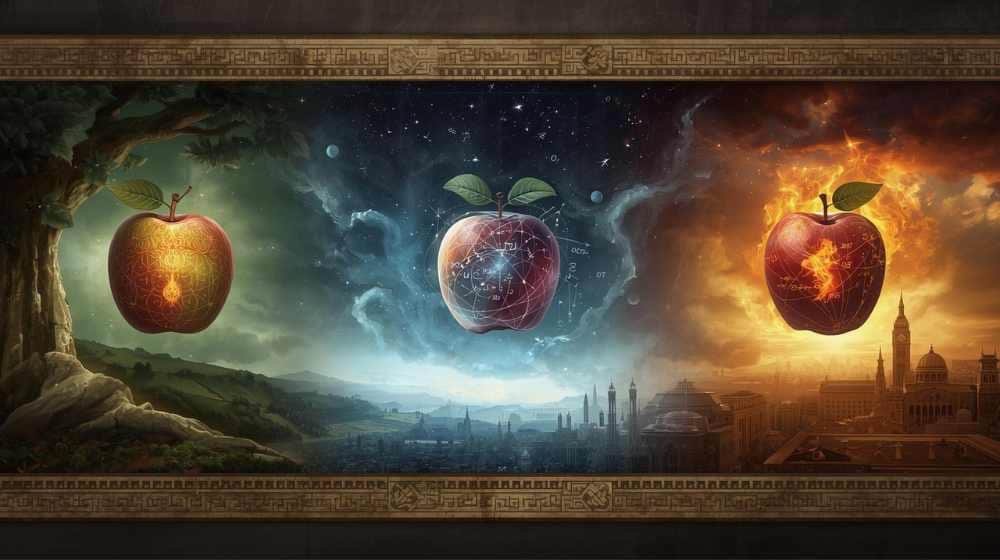
Among these pivotal events, three apples stand out as symbols of profound change: the Apple of Knowledge from the biblical story of Adam and Eve, the Apple of Newton that led to the discovery of gravity, and the Apple of Innovation—the iPhone, which transformed the digital age. Each of these “apples” sparked new ways of thinking, living, and interacting with the world, and continues to have lasting effects on humanity. Let’s explore the significance of these three apples and how they have shaped the course of human history.
The First Apple: The Apple of Knowledge in the Garden of Eden

The Beginning of Human Consciousness and Knowledge
The Apples of Knowledge is one of the most iconic symbols in human culture, originating from the biblical story of Adam and Eve. In this story, God created the first humans and placed them in the Garden of Eden, a paradise where they lived in harmony with nature. However, there was one rule: they were not to eat the fruit from the Tree of Knowledge of Good and Evil.
Eve, tempted by the serpent, ate the forbidden fruit and shared it with Adam. This act of disobedience marked a turning point in the story of humanity, as it led to their expulsion from Eden. But more importantly, the consumption of the apple symbolized the acquisition of knowledge—the knowledge of good and evil, and the awareness of their own existence and limitations.
The Symbolism and Effects of the Apples of Knowledge
Though this story is mythological, the Apples of Knowledge is an enduring metaphor for the acquisition of self-awareness and intellectual development. The fruit in this tale represents a fundamental shift in human existence: the transition from innocence and ignorance to awareness, free will, and the ability to make choices. The moment Adam and Eve ate the apples, they gained consciousness—they became aware of their own nakedness, vulnerability, and mortality.
This shift in consciousness is often seen as the moment humanity began to understand the world in more complex terms. It was the dawn of intellectual pursuit—humans began to seek answers to life’s big questions, such as the meaning of existence, morality, and the nature of the universe. The acquisition of knowledge laid the foundation for the development of philosophy, science, and religion, all of which would guide humanity’s intellectual and moral development for millennia.
In a broader sense, the Apples of Knowledge symbolizes humanity’s innate curiosity—a characteristic that continues to drive human progress. Every intellectual, artistic, or scientific breakthrough has been fueled by the desire to understand the world better, just as Adam and Eve’s curiosity led to their transformative act of eating the forbidden fruit.
The Birth of Free Will and Ethical Thought
The moment Adam and Eve ate the apples, they gained not only knowledge but also the awareness of their freedom to choose between right and wrong. This introduction of free will, a concept central to human nature, marked the beginning of moral philosophy. It was the first spark of ethical reasoning and the realization that actions have consequences.
This philosophical turning point has shaped human history by providing the foundation for ethical systems, laws, and governance. The ability to choose freely and to act with an understanding of right and wrong remains at the core of human civilization today. The Apple of Knowledge thus symbolizes not just intellectual awakening but the beginning of humanity’s moral and ethical journey.
The Second Apple: Newton’s Apple and the Discovery of Gravity

A Simple Fruit, A Groundbreaking Discovery
The second apple that shaped human history is the famous apple that fell on Isaac Newton’s head in the 17th century. While there is some debate over whether the apples actually fell on his head, the story has become a powerful symbol of the moment that sparked one of the most important scientific breakthroughs in history.
As Newton sat under a tree, contemplating the nature of gravity, the falling apple caused him to ask a simple yet profound question: “Why does the apples fall straight down, rather than sideways or in some other direction?” This observation led him to develop the theory of universal gravitation, which explained that gravity is a force that pulls objects toward the center of the Earth, as well as the law of motion, which described how objects move in response to forces.
The Impact of Newton’s Discovery on Human Understanding
Newton’s work laid the foundation for classical physics and gave humanity a new understanding of the universe. His discovery of gravity and the laws of motion revolutionized not just physics, but every branch of science. Before Newton, people had little understanding of why objects fell to the ground or how celestial bodies moved in space. Newton’s work unified terrestrial and celestial mechanics, showing that the same laws that govern the falling apple also govern the movement of planets and stars.
His laws provided a framework for understanding the natural world that lasted for centuries. Newton’s work in mathematics, optics, and mechanics formed the bedrock of modern science, influencing the work of future scientists like Albert Einstein, who later expanded on Newton’s laws with the theory of relativity.
Newton’s Apple and the Age of Enlightenment
Newton’s apple symbolized more than just a scientific discovery—it was a symbol of intellectual progress. The Enlightenment era, which followed in the 18th century, was fueled by ideas of reason, scientific inquiry, and progress. Newton’s work was a cornerstone of the intellectual revolution that transformed Western thought. His discoveries made people believe that through observation, experimentation, and rational thinking, humanity could unlock the secrets of the universe.
Newton’s apple, then, did not just change science—it changed how people thought about the world. It sparked a new era of exploration and understanding, laying the groundwork for technological innovations and scientific progress that would follow in the centuries to come.
The Third Apple: The iPhone and the Digital Revolution
A New Apple for a New Era
The third apple in this sequence is the iPhone, released by Apple Inc. in 2007. While the iPhone is not the first smartphone, it is the one that revolutionized the way we interact with technology. With its sleek design, touch interface, and integration of the internet, the iPhone brought computing power into the palm of our hands. It combined a phone, computer, music player, and camera into one portable device, fundamentally altering how people communicate, work, and live.
Unlike earlier smartphones, the iPhone introduced the concept of the app—small software applications that could be downloaded to perform a wide range of tasks. From checking emails and browsing the internet to playing games and socializing, the iPhone brought the digital world to our fingertips, making technology more accessible, practical, and personal than ever before.
How the iPhone Changed the World
The iPhone is perhaps the most transformative product of the 21st century. It reshaped entire industries—from communication and entertainment to retail and finance. The iPhone made the internet mobile, and with it came the rise of mobile apps, online shopping, social media, and instant messaging. It created new opportunities for businesses, startups, and developers to reach global audiences in ways previously unimaginable.
The iPhone has also changed the way we consume information. With a few taps on the screen, people can access an endless stream of news, entertainment, and education. Social media platforms like Facebook, Twitter, and Instagram exploded in popularity with the rise of smartphones, turning the way people connect and share into a global phenomenon.
The iPhone and the Rise of the Digital Age
The introduction of the iPhone marked the beginning of the digital age, where computing, communication, and entertainment converged into a single device. It sparked the development of other mobile technologies, such as tablets, smartwatches, and wearable fitness trackers, which have further transformed how people interact with technology.
The iPhone also revolutionized industries like photography, music, and navigation. It made high-quality photography accessible to millions, changed how we consume music through streaming platforms, and provided GPS navigation that allowed people to navigate the world with ease. More than just a phone, the iPhone became a portal to the digital world.
The iPhone’s Impact on Society
Beyond the technological advancements, the iPhone has had a significant cultural impact. It has changed the way people live, work, and socialize. It has made communication faster and more convenient, allowing people to connect with others across the globe instantly. It has also contributed to the rise of the “gig economy,” where people can work, sell products, and share content directly from their smartphones.
However, the iPhone also raises questions about privacy, addiction, and its impact on face-to-face communication. While the device has made life easier in many ways, it has also brought challenges, including concerns about screen time, social media pressures, and the erosion of privacy in the digital world.
The Lasting Legacy of the Three Apples
The three apples—the Apple of Knowledge, the Apple of Newton, and the Apple of Innovation—have shaped humanity in profound ways. Each apples represents a transformative moment that led to new ways of thinking, understanding, and interacting with the world. The first apple symbolized humanity’s awakening to knowledge and moral responsibility. The second apple represented the dawn of scientific discovery, reshaping our understanding of the physical world. The third apple, the iPhone, represents the digital revolution, changing how we communicate, work, and live.
These three apples, in their own unique ways, have created ripples of change that continue to influence human history. From the earliest moments of human consciousness to the digital age of today, these apples symbolize the endless pursuit of knowledge, innovation, and progress that defines human civilization. As we look to the future, the question remains: What will be the next apples to transform our world?